
A policy on paper changes very little. The schools seeing real drops in fights, referrals, tardies, and hallway wandering didn’t just write a rule — they physically secured the phones.
Here’s what the behavior data actually shows, outcome by outcome, with the sources so you can check the work yourself.
There’s a meaningful difference between three things a school can do about phones: nothing, a written policy, or a physical solution that actually secures the device. The behavior data increasingly shows those three produce very different results.
The gap between “we have a policy” and “the phones are genuinely put away” is where the real improvement lives. Let me walk through what schools are actually measuring, outcome by outcome.
1. Fewer fights — and far less filming of them
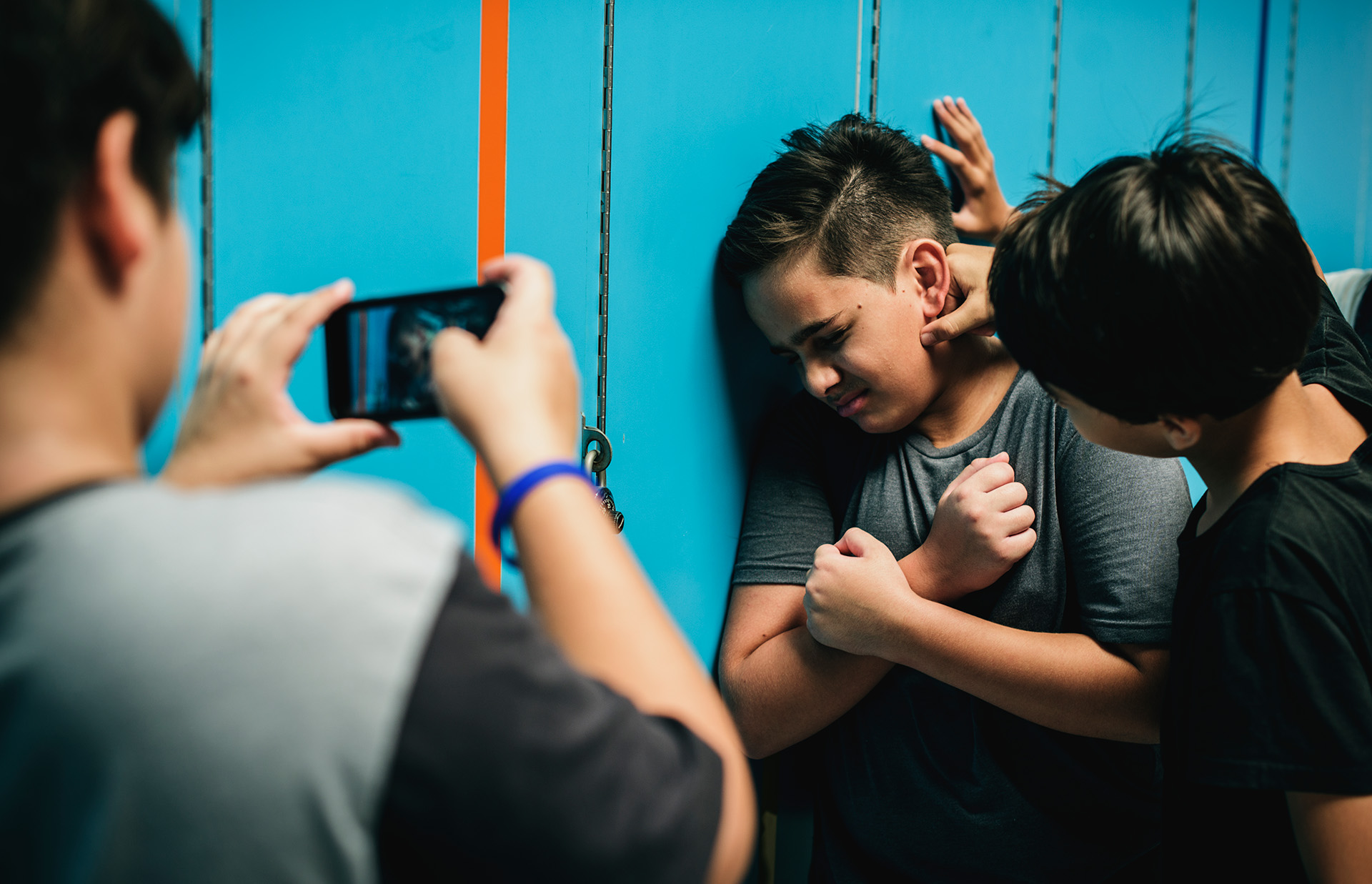
The link between phones and school violence isn’t only about distraction; it’s about the audience effect. The ability to film a fight and broadcast it live has, in the words of one 2026 policy review, “gamified school violence, encouraging physical altercations for clout.”9 Take away the camera and you take away a real part of the incentive to fight.
The principals who manage this every day see it directly. In a 2025 RAND Corporation survey of roughly 8,000 K-12 principals, about two-thirds reported fewer incidents of students using phones for inappropriate behavior — explicitly including recording fights and filming classmates — after restrictions took hold.2 When Los Angeles Unified moved to phone-free campuses, the board member who authored the resolution summarized what schools reported: “fights were down, drug sales were down and kids were reporting a better school day.”5
The mechanism matters here, and it’s why securing the phone outperforms a policy. A phone in a pocket under a “no phones” rule can still come out in two seconds to film a hallway scuffle. A phone that’s physically secured cannot. The deterrent only works if the camera is genuinely unavailable.
2. Fewer discipline referrals
This is where the numbers are most striking, and where the contrast between “policy” and “secured” is clearest. North Adams Public Schools in Massachusetts expected modest gains. As assistant superintendent Timothy Callahan put it: “A 10 percent reduction would’ve been a win. We saw a 75 percent drop in referrals in the last quarter of the 2024 school year” compared with the same quarter the prior year — a drop he said was “almost completely attributable to the cellphone ban and the use of pouches.”1
Note that detail: the ban and the pouches. Not the ban alone. The same pattern shows up across districts that physically secured phones — Medina, New York reported a clear drop in referrals after a bell-to-bell policy,7 and Gravette, Arkansas reported substantially fewer phone-related referrals after moving to a zero-tolerance, centrally enforced model. Crucially, the Gravette superintendent noted that enforcement moving from individual teachers to a consistent system was what made the difference8 — exactly the gap a physical tool closes.
The largest study to date backs the direction. A 2026 National Bureau of Economic Research analysis of about 4,600 schools — led by scholars at Stanford, Duke, Michigan, and Penn — found that in schools securing phones bell-to-bell, the share of students using phones in class for personal reasons fell from 61 percent to 13 percent, with device activity dropping roughly 30 percent by the third year.3 Fewer phones out means fewer of the conflicts, recordings, and confrontations that generate referrals in the first place.
3. Fewer tardies and less class-skipping
This outcome gets less attention but matters enormously for instructional time. The same North Adams leader who reported the 75 percent referral drop also noted that issues like “students skipping class or detention, or being out of class without permission, have also reduced massively” after the phone ban and pouches went in.1
There’s a logic to it. The phone is the magnet that pulls a student into a bathroom for twenty minutes, that makes the walk between classes stretch into a hallway hangout, that turns a bathroom pass into a scrolling break. Remove the device from play and the incentive to be anywhere but class drops with it. The most rigorous evidence reinforces this from a different angle: an NBER study of a large Florida district found that securing phones reduced unexcused absences, and that improved attendance accounted for roughly half of the eventual academic gains.4 Attendance and presence improve quickly — they’re often the first thing schools notice.
4. Fewer students wandering during class
Ask a principal what the phone changed about the building itself, and you’ll often hear about attention and presence. Dr. Sandy Hattar, principal at Yonkers Middle High School, described students who “always wanted to know what was going on in the bathrooms, in the next room or across the hall instead of being centered in the classroom”6 — the restless, half-present churn that a phone feeds. When the phone is secured, that pull disappears.
The before-and-after picture educators describe is consistent: hallways that go quiet during class because students are actually in their seats, and louder at passing time and lunch because students are talking to each other instead of scrolling. In the national data, the share of students reporting personal phone use in class collapsing from 61 percent to 13 percent is this change, measured — students physically and mentally back in the room.3
Policy vs. no policy vs. secured
| Approach | What typically happens |
|---|---|
| No policy | Phones ubiquitous. Filming of fights, constant distraction, hallway wandering, and referrals run at full volume. The audience effect actively rewards conflict. |
| Policy only | Enforcement falls on individual teachers and varies room to room. Students learn the gaps. RAND found compliance hinges on each teacher’s perceived strictness — and roughly half of students still check phones daily even under restrictive policies. Improvement is real but inconsistent, and erodes over the year. |
| Policy + physical securing | The phone is genuinely unavailable, uniformly, in every room. This is where the largest, most consistent drops in referrals, fights, tardies, and wandering show up — because enforcement no longer depends on willpower. |
The throughline in the strongest results — North Adams, Gravette, LAUSD — is the same: the improvement is attributed not to the rule alone but to the rule plus a physical mechanism that secures the phone. A policy sets the expectation. Securing the phone is what makes the expectation real for every student in every room, which is what turns modest, uneven gains into the building-wide drops the data shows.
What the research doesn’t promise
The evidence isn’t uniformly rosy, and you should hear that from us before you build a board presentation on it. The same large 2026 NBER analysis found behavior and academic gains are slow and uneven in the first year.3 The Florida study found suspensions actually rose about 25 percent in the first month of its ban, disproportionately among Black students, before settling back to baseline by year three.4
Securing phones is not a magic switch. It’s a structural change that pays off most when implemented consistently and given time, with a rollout that anticipates the early adjustment period. Dramatic single-district results like North Adams’ 75 percent drop are real, but they represent strong implementations — not guaranteed averages. Plan for a bumpy first six weeks and a much calmer second year.
Where Safe Pouch fits
Everything above points to one conclusion: the schools getting results aren’t the ones with the best-worded policy — they’re the ones that physically secured the phone in a way that takes enforcement off individual teachers. That’s precisely what Safe Pouch is built to do.
Safe Pouch secures the phone with a mechanical lock released by a magnet of the correct strength and pattern, so the device is genuinely unavailable during class — not merely “supposed to be away.” Because students keep their own pouch and any teacher can release it at the door in seconds with a Teacher Magnet Unlocker, there’s no centralized unlocking station and no dismissal bottleneck. Enforcement becomes uniform across every classroom rather than depending on which teacher is in the room — closing exactly the consistency gap the RAND data identifies as the reason policy-only approaches erode.2
Lock color sets the release tier, so your campus decides who can open what: the Black Home Lock is parent-released, the Grey School Lock is teacher-released, and the White Admin Lock is administrator-only. And every pouch includes a dedicated cut point anyone can use with no Magnet Unlocker, repaired free under warranty — so staff are never waiting on a device to reach a student in an emergency.
Across districts, the biggest and most durable drops in fights, referrals, tardies, and hallway wandering come from schools that physically secured phones — not from schools that merely wrote a rule.
The deciding variable isn’t the strength of the policy. It’s whether the phone is genuinely unavailable. A tool that secures the device uniformly, without burdening teachers, is what turns a policy on paper into the calmer, more focused building the data describes.
Frequently Asked Questions
Why does securing phones beat just having a strong policy?
Because a policy delegates enforcement to individual teachers, and RAND found compliance depends heavily on each teacher’s perceived strictness — roughly half of students still check phones daily even under restrictive policies. The districts with the largest drops in referrals and fights consistently credit the policy plus a physical securing method, not the rule alone. Securing the phone makes enforcement uniform, so it doesn’t erode room to room over the year.
How do phones contribute to fights specifically?
Through the audience effect. The ability to film a fight and post it rewards conflict with attention — one policy review described it as gamifying school violence for clout. Roughly two-thirds of principals in RAND’s survey reported fewer incidents of students recording fights or filming classmates after restrictions. Remove the available camera and you remove a real part of the incentive to fight.
Do phone restrictions really reduce tardies and class-skipping?
Districts report so. North Adams’ assistant superintendent said students skipping class or being out of class without permission reduced “massively” after the ban and pouches. The Florida NBER study found securing phones reduced unexcused absences, with better attendance driving about half the academic gains. The phone is often the reason a student lingers in a bathroom or hallway; removing it from play reduces the pull.
Is the evidence solid, or is this overstated?
It’s solid on direction but honest about nuance. Single-district results like North Adams’ 75 percent referral drop reflect strong implementations. The largest national study of about 4,600 schools found gains are slower and more uneven, and the Florida study found suspensions rose initially before settling by year three. The consistent finding is that behavior, climate, and attendance improve — fastest and most reliably when phones are physically secured and the policy is sustained.
How is Safe Pouch different from collecting phones in a bin?
Collecting phones creates liability and a daily bottleneck, and centralized lockers or unlocking stations create a dismissal pileup. Safe Pouch lets students keep their own device secured by a mechanical lock released by a magnet of the correct strength and pattern, with a teacher releasing it at the door in seconds using a Teacher Magnet Unlocker. Enforcement stays uniform across classrooms, and a dedicated cut point anyone can use with no Magnet Unlocker — repaired free under warranty — keeps emergency access immediate.
What does it cost, and how do schools fund it?
Safe Pouch is available as low as $13.50 per pouch depending on volume, and schools most often fund it through Title I, Title IV-A, MTSS/PBIS or school climate budgets, safety grants, or community sponsorship. Because Win Elements holds TIPS Cooperative Purchasing Contract #250802 through 10/31/2030, purchases are EDGAR-compliant and sole-source, with no competitive bid required. Note that inventory is reserved only on a purchase order or payment — quotes do not hold stock.
Fewer Fights, Fewer Referrals, More Learning
Safe Pouch physically secures phones so the behavior gains the research describes become your building’s everyday normal — without making teachers the phone police. We’ll map the funding pathway with you: Title I, Title IV-A, MTSS/PBIS, safety grants, or community sponsorship.
Sources
- Education Week, North Adams Public Schools referral data (2025).
- RAND Corporation, national principal survey, ~8,000 K-12 principals (2025).
- NBC News reporting on the national NBER study, ~4,600 schools (Dee et al., 2026).
- National Bureau of Economic Research, Florida district study (Figlio & Özek, 2025).
- Los Angeles Times, Los Angeles Unified School District (2025).
- CBS News, Yonkers Middle High School (2025).
- Orleans Hub, Medina Central School District (2026).
- Gravette School District board report (2025).
- GovFacts, state phone policy review (2026).
Findings are summarized in the author’s own words. Product details describe Win Elements’ Safe Pouch. All sources accessed and verified June 2026.
