
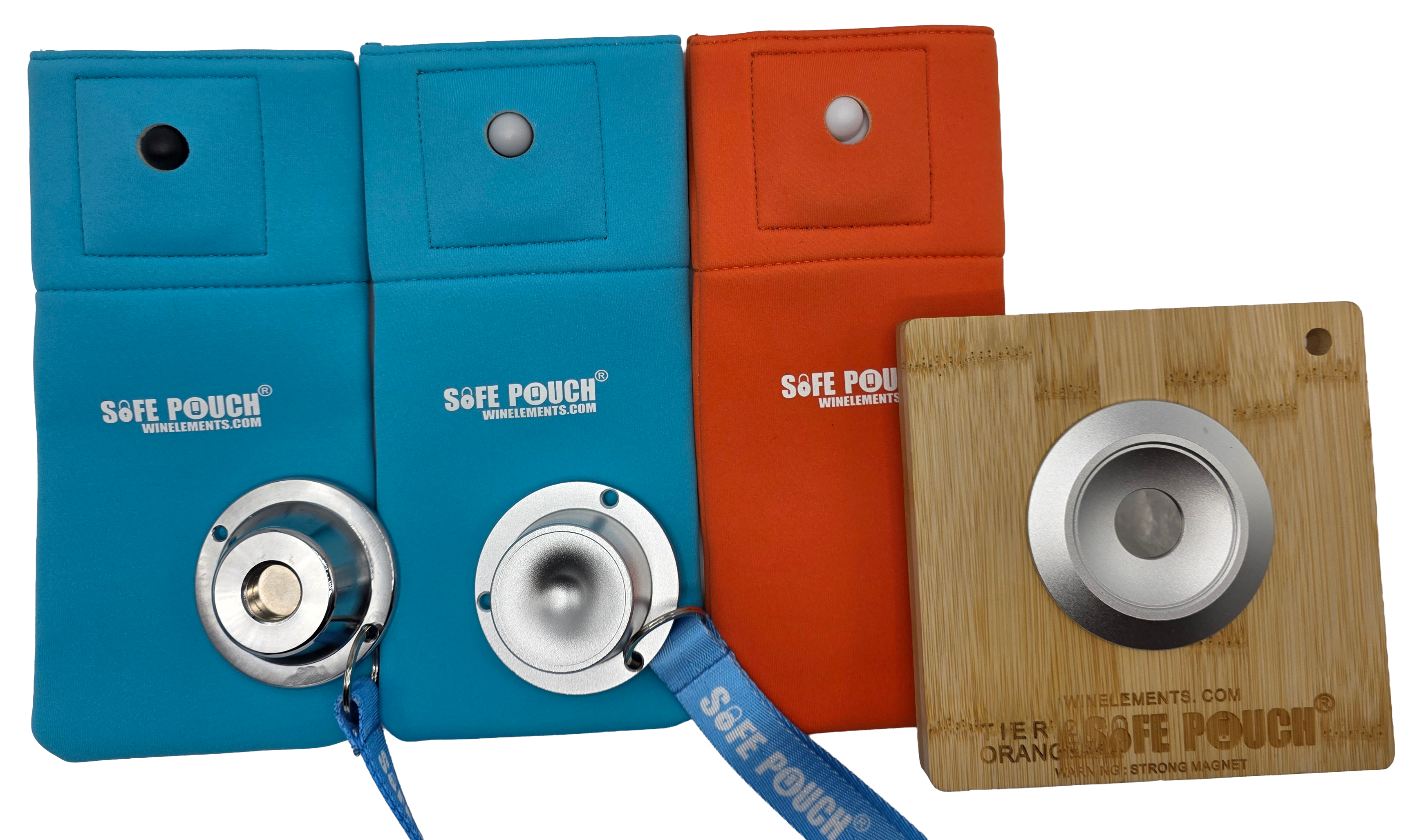
Which Safe Pouch® Implementation Model Fits Your School?
There’s no single “right” way to roll out Safe Pouch®. Three implementation paths reach different levels of commitment — from a full whole-school system to a low-risk enforcement-only pilot — and all three plug into the cell phone policy your school already has. This guide walks through the most common scenarios and shows which path fits, with the trade-offs spelled out honestly.
The three models, in three sentences each
Model A · Decentralized Teacher-Led
Every teacher holds a numbered Magnet Unlocker. The last-period teacher unlocks each student’s pouch in the classroom before the bell, so students walk out already released.
Model B · Self-Service Magnet Stations
Mounted Magnet Enclosures sit at distributed points across the school. Designated staff open them minutes before the bell, and students unlock their own pouch at the nearest station.
Model C · Room-Numbered Consequence Set
No pouch for every student — just five room-numbered pouches per teacher, used only when a student is caught with a phone out. The lowest-commitment way to add real enforcement to a policy you already have.
All three use the same Safe Pouch® system: a mechanical lock released by a magnet of the correct strength and pattern. Models A and B secure every student’s device all day and make dismissal bottleneck-free. Model C does something different — it doesn’t touch students who follow the rules at all, and only engages when the rule is broken. You aren’t choosing which policy to adopt. You’re choosing how much of a commitment to make this year.
Start with the policy you already have
Most schools already have a phone policy — off and away for the day, an honor system, a bell-to-bell ban, or something in between. In California, AB 3216 made sure every school has one. The question isn’t whether your policy is sound. It’s whether anyone has a physical tool to back it up when a student ignores it.
That’s the entire integration decision. Your policy stays exactly as written. What changes is where the unlocking authority lives — in every classroom (Model A), distributed across staff and stations (Model B), or held only by the office and triggered only on a violation (Model C).
Ask yourself: do we want to secure every device, every day, campus-wide? Or do we want a consequence tool for the students who don’t comply with the policy we already have? Both are legitimate starting points — and you can move between them later without buying anything twice, since pouches and Magnet Unlockers are compatible across all three models.
Model A and B side by side, step by step
These two models secure every student’s device, all day. Read across each row to compare what’s happening at the same moment in each.
Issue pouches + assign a Magnet Unlocker to every teacher
Each student gets an assigned Safe Pouch®. Each teacher gets a numbered handheld Magnet Unlocker.
Issue pouches + mount enclosures
Each student gets an assigned Safe Pouch®. A small set of Magnet Enclosures is mounted at distributed unlock points. Supervisors carry Mobile Magnet Unlockers.
Students seal devices · teacher verifies
Students power off devices and seal them in their own pouch. First-period teacher verifies through the access holes — no magnet needed.
Students seal devices · teacher verifies
Same routine, verified through the access holes. Enclosures remain closed and locked.
Magnet Unlockers ready in every room
Accommodations and emergencies handled on the spot by the adult who knows the students.
Enclosures locked · supervisors patrol
Station Magnet Unlockers stay locked inside enclosures. Supervisors respond with Mobile Magnet Unlockers.
Teacher unlocks while students are seated
Before the bell, the teacher unlocks each pouch. Students leave already unlocked.
Teacher double-checks each pouch
Required: check every pouch and report damage immediately. Staff open enclosures minutes before the bell.
Students walk out — already unlocked
No lines, no central choke point. Every classroom releases its own students.
Students unlock at the nearest station
The crowd splits naturally across multiple stations.
Students hand back the unlocked pouch on the way out
After the dismissal unlock, students hand the unlocked pouch to a staff member at the exit door. Stored overnight, reissued at arrival. Best fit: smaller campuses and K–5 schools.
Apply the consequence ladder
1st: confiscate, pick-up after school. 2nd: guardian pick-up. 3rd: guardian pick-up + conference.
Apply the consequence ladder
Same ladder as Model A.
Not ready for a whole-school rollout? Model C
Model C doesn’t run in parallel with A and B all day — it only activates when a student breaks the rule. Here’s the whole sequence.
Five room-numbered pouches per teacher
Each teacher gets five Safe Pouch® units labeled by room (e.g., Room 214-1 to 214-5). The pouch locks on closing — no tool needed. Only the main office holds the release Magnet Unlocker.
No pouches in play
Students keep their phones by default. Students who follow the policy are never pouched.
Caught with a phone out → pouched on the spot
The teacher locks the phone in a room-numbered pouch and logs only the pouch number and student name. The student carries the locked pouch the rest of the day — no office trip, no standoff.
Pouched student reports to the main office
The student returns the locked pouch. First offense: office staff unlock and return the phone. Repeat offenders: phone held for parent pick-up.
Pouch back in the set, incident on record
The office matches the pouch number to the logged student and returns the pouch to its room set. Damaged or lost pouch: the phone is held until the replacement is paid, keeping the room set intact.
Notice what never happens in that sequence: no student sent out of class, no administrator pulled from their day to run a confiscation. The teacher resolves it in the room in under a minute — your support staff only handle the rare repeat case, not every phone violation on campus.
Eight common school scenarios
Each scenario below describes a real challenge schools wrestle with, the model that tends to fit, and why. Most schools recognize themselves in more than one — that’s a sign the right answer is probably a blend.
You’re currently running an honor system or off-and-away policy
The challenge: your policy already says phones off and away. The rule isn’t the problem — there’s nothing physical to back it up when a student ignores it, and you’re not ready to buy a pouch for every student to find out if that’s even needed.
Best fit: Model C (Room-Numbered Enforcement-Only)This is exactly the gap Model C is built for. Students who comply are never touched by the system at all — nothing changes for them. The few who test the rule get pouched on the spot, in the room, with no office trip. It’s a real consequence layered onto the policy you already have, without a full-school purchase.
Watch out for: Model C only manages the exception cases. If a large share of your students routinely ignore the policy, the room-numbered set can run thin fast — that’s usually the signal it’s time to move to Model A or B.
You want to pilot before committing campus-wide
The challenge: you’re interested in a whole-school system eventually, but your board, budget cycle, or staff buy-in isn’t there yet this year.
Best fit: Model C (Room-Numbered Enforcement-Only)Model C is the lowest-risk way to generate real data before a bigger ask. Run it for a semester, then bring your own incident log to the budget conversation — how many pouches were used, how many repeat offenders, how it changed classroom behavior. That’s a stronger case than a projection.
Watch out for: because Model C only pouches the minority who break the rule, it won’t tell you much about dismissal bottlenecks or daily compliance friction — those only show up once you run Model A or B.
You’re a small school with a mostly compliant student body
The challenge: a tight budget, limited staff capacity to manage a new routine, and a phone problem that’s real but limited to a handful of students.
Best fit: Model C (Room-Numbered Enforcement-Only)If most students already comply and the problem is a small, known group, a whole-school rollout is more system than you need. Five pouches per teacher covers it, and the office can track exactly who’s testing the policy without equipping every student.
Watch out for: if this scenario grows — more students testing the rule than five pouches per room can handle — that’s the signal to look at Model B for a whole-school, budget-conscious upgrade.
You’re a large high school with multiple wings and complex dismissal
The challenge: 1,500+ students, several exit points, staggered bell schedules, and dismissal that already involves coordination across multiple staff.
Best fit: Model A (Decentralized Teacher-Led)On a large campus, the most reliable way to avoid a single chokepoint is to let every classroom release its own students. Each last-period teacher unlocks pouches while students are seated, so the building empties evenly when the bell rings.
Watch out for: Model A’s strength depends on every last-period teacher following the unlock routine consistently — clear training, a substitute-teacher backup plan, and admin spot-checks in the first weeks all matter.
You have a tight budget for Magnet Unlockers, but want whole-school coverage
The challenge: equipping every teacher with a Magnet Unlocker is more than the line item your business manager wants to approve this year, but you’re past the pilot stage and want every student secured.
Best fit: Model B (Self-Service Magnet Stations)One Magnet Unlocker per station — rather than one per teacher — drops the count significantly. Add a few Mobile Magnet Unlockers for supervisors, and your total purchase stays well below the per-teacher number, while still covering every student.
Watch out for: Model B’s accountability depends on the enclosure open/close routine being followed every day. Schools that struggle with Model B usually struggle because the daily routine drifts, not because the model failed.
You have heavy accommodation needs (504s, IEPs, medical)
The challenge: a meaningful share of your students need access to their device during the day for legitimate medical, communication, or learning reasons.
Best fit: Model A (Decentralized Teacher-Led)When a known adult and a Magnet Unlocker are already in the room, accommodation and emergency unlocks happen on the spot — no walk to the front office, no waiting.
Watch out for: Model B can still serve accommodation-heavy schools well if supervisors with Mobile Magnet Unlockers are visible and quick to respond. Many schools blend the two.
Your dismissal is rough, chaotic, or has known safety concerns
The challenge: rushed exits, crowding at doors, or supervision gaps that make adding another step risky. Bottlenecks are also a real liability during an evacuation or lockdown, not just at 3pm.
Best fit: Model A (Decentralized Teacher-Led)Model A completes the unlock before the bell, in the classroom, with students seated. By the time students leave the room, they’re already released — no new choke point, no single point that has to be unwound before a student can reach a parent or first responder in an emergency.
Watch out for: Model B can also work here if stations sit along natural flow lines and supervisors are positioned to respond quickly.
You want the system to mirror your MTSS or PBIS framework
The challenge: you don’t want a phone tool that sits outside your existing intervention structure — you want the escalation to match what your team already runs.
Best fit: Any model, using lock tiersLock tiers are separate from the implementation model. Standard students use teacher-release locks; Tier 2 intervention students can be assigned a stricter tier without buying different equipment. This works whether you’re running A, B, or C — the tier structure your MTSS/PBIS team already uses is the same structure the pouches enforce.
Quick decision matrix
| Your situation | Best fit | Why |
|---|---|---|
| Currently running an honor system / off-and-away policy | Model C | Real consequence for the exceptions, no full purchase |
| Want to pilot before a full commitment | Model C | Lowest-risk way to generate real usage data |
| Small school, mostly compliant students | Model C | Five pouches per teacher covers the known problem group |
| Large high school, multiple wings | Model A | Every classroom releases its own students — no central choke |
| Whole-school coverage, tight magnet budget | Model B | One Magnet Unlocker per station, not one per teacher |
| Heavy accommodation needs | Model A | Known adult + Magnet Unlocker in every room, no delay |
| Rough dismissal or emergency-preparedness concerns | Model A | Unlock completes before the bell, no bottleneck during an evacuation |
| Mixed — large school + tight budget + accommodations | Blend (A + B) | Stations for general dismissal, teacher-led for accommodation-heavy rooms |
An Honest Caveat
No model fixes culture problems on its own. If a school has unclear consequence ladders, inconsistent enforcement, or rocky relationships between students and staff, the pouch routine — whichever model — will struggle. And Model C specifically isn’t meant as a permanent solution for a campus with widespread noncompliance; it’s built for the exceptions, not the majority. The Safe Pouch® system makes a sound policy easier to execute consistently — it doesn’t replace the policy work itself.
The blended approach — and mixing across a district
After a year or two, many schools settle into a blend rather than a pure single-model implementation. A common pattern for a large campus:
- Self-service Magnet Stations handle the bulk of general-population dismissal.
- Teachers in classrooms with high accommodation needs carry their own Magnet Unlocker for on-the-spot access.
- Campus supervisors and front-office staff carry Mobile Magnet Unlockers for emergencies and exceptions.
Districts often mix models across sites entirely — Model A at the high school where dismissal complexity justifies the investment, Model C at middle schools still running an honor system, Model B somewhere in between. Every pouch, Magnet Unlocker, and consequence ladder stays consistent district-wide, and nothing purchased for one model is wasted if a site moves to another.
What integration actually costs
Built to be fixed, not replaced
Locking parts are modular — a worn part gets a free replacement, not a new pouch. Every Safe Pouch® carries a three-year free repair warranty, intentional damage included, with no claim forms and no photos required. Schools ship it in, we repair it, and send it back. Pouches are machine washable, upgradeable, and backward-compatible, so a school that grows from Model C into Model A never rebuys its foundation.
Pricing starts as low as $13.50 per pouch, and most schools fund their rollout through pathways already in their budget: Title I, Title IV-A, MTSS/PBIS, Perkins/CTE, community sponsorship, or parent reimbursement. Schools purchasing through the TIPS cooperative contract (#250802) can skip the competitive bid process entirely.
Frequently asked questions
Do we have to buy a pouch for every student?
We’re currently running an honor system — does this fit?
How many Magnet Unlockers does a typical school need?
What happens if a student forgets, damages, or loses their pouch?
Can we switch models later?
How does verification work without unlocking?
What about emergencies — what if a student needs their phone right away?
Does the pouch lock on its own at a certain time or location?
How do we fund this?
Not sure which model fits your campus? John — a full-time California classroom teacher and the inventor of the Multi-Tiered Safe Pouch — walks administrators through it in a 10-minute demo, phone or online, with a free sample shipped after the call.
Book a 10-Minute Demo