
By John Nguyen — credentialed classroom teacher (15+ years), founder of Win Elements, and inventor of the Multi-Tiered Safe Pouch® (U.S. Patent No. 10,980,324 B2)
Every fall, I hear the same sentence from principals: “We love it — but we missed the window. We’ll launch next August.”
I understand where that comes from. And let me say clearly: if your current phone approach is holding, that’s real work by your staff and it deserves credit. But if phones are creeping back now that the honeymoon weeks are over, I have good news from fifteen-plus years in the classroom and thousands of pouches in the field:
There is no window. In fact, launching a school phone ban with the Multi-Tiered Safe Pouch after the year starts is often more effective than a Day 1 launch — because of two design decisions at the heart of the system: it’s decentralized, and safety comes first, where students and parents can see it with their own eyes. Whether your state has passed a bell-to-bell phone ban or your board is writing its own policy, the calendar is not the obstacle it looks like.
Where the “Day 1 or wait a year” myth comes from
The myth is real — for centralized systems. Programs built around unlocking stations, sealed fabric pouches, or centralized phone lockers need infrastructure: hardware mounted, stations positioned, staff retrained on collection and distribution routines. That’s why they naturally push schools toward a summer install and an August launch. Miss it, and “next year” feels like the only option.
Safe Pouch has no infrastructure to install. Nothing gets mounted before you can start (wall-mounted Magnet Enclosures are an option, not a prerequisite). The launch is a 15–20 minute staff meeting and one morning at the doors. Here’s what that difference looks like on a calendar:
Time From “Yes” to “Launched”
Why centralized systems wait for August — and Safe Pouch doesn’t
Nothing to install — pouches distribute at the doors, and every teacher’s Magnet Unlocker works on day one.
Four reasons a late start actually works in your favor
Teachers have felt the need
In August, a phone policy is a hypothesis. By October, every teacher has lived the problem. Buy-in isn’t a persuasion campaign anymore — it’s relief.
You scope with real data
You now know which periods, hallways, and grade levels need the most support — so your implementation model and pouch counts fit your actual campus, not a summer guess.
Students & parents see it live
Trust isn’t built by a letter home — it’s built by watching a pouch open in seconds in every classroom and seeing the emergency access with their own eyes.
You get a true before/after
Launch late-start and your own campus becomes the case study — referrals and interventions before vs. after, tracked live in MySafePouch.
The design decision that makes it possible: decentralization
Centralized systems concentrate everything — unlocking, storage, accountability — in a few fixed points. That’s exactly why they’re hard to launch late-start and slow to run every day. Safe Pouch inverts the architecture: in our most effective model (Model A), every teacher carries a numbered Magnet Unlocker, and every pouch opens with a mechanical lock released by a magnet of the correct strength and pattern. The “infrastructure” walks into the building each morning in your teachers’ hands.
Centralized systems
Every unlock funnels to a few fixed points
STATION
Hundreds of students, a handful of stations: lines at dismissal, gaps in emergencies, installation before launch.
Multi-Tiered Safe Pouch
Every classroom is an unlocking point
101
102
103
104
105
106
107
108
A Magnet Unlocker in every teacher’s hands (Model A) or self-service Magnet Enclosure stations (Model B): pouches open campus-wide in seconds, launch any week of the year.
Safety first — where everyone can see it
Here’s the part that changes parent meetings. Every Safe Pouch has a built-in emergency safety access: a dedicated cut point that anyone — student or staff — can use in seconds, with no Magnet Unlocker required. When you launch after the year has started, you don’t ask families to trust a brochure. You demonstrate it in the gym, in first period, at back-to-school night:
The 30-second demo that wins the room
1. A teacher opens a pouch in front of everyone — seconds, right there in the classroom.
2. Someone cuts the emergency access point on a demo pouch — no tools hunt, no waiting for the office.
3. You tell parents the pouch they just watched get cut will be repaired free under warranty — because a safety feature you’re afraid to use isn’t a safety feature.
Students and parents don’t have to imagine how the system behaves in an emergency. They’ve already watched it.
The rest of the system escalates just as visibly. Lock color is authority level — a Grey School Lock opens with any teacher’s Magnet Unlocker, a White Admin Lock only in the office, and a Black Home Lock puts the release decision in a parent’s hands. Forgot-at-home days get a Tier 2 numbered loaner; damaged pouches and repeat violations move to the Tier 3 phone storage cabinet. Every exception has a calm, pre-decided answer — which matters twice as much in a late-start launch, when students will absolutely test whether the new policy is real.
Your launch week, start to finish
A late-start launch = your own before-and-after story
This is the quiet superpower of a late start. A Day 1 launch has no baseline — you’ll never know what the year would have looked like. A late-start launch gives you weeks of real “before”: referrals, redirections, hallway incidents. Then MySafePouch (free for 3 years for Safe Pouch schools) tracks the “after” automatically — live inventory, one-step intervention logging, and CSV exports your MTSS/PBIS team can put straight into a board slide.
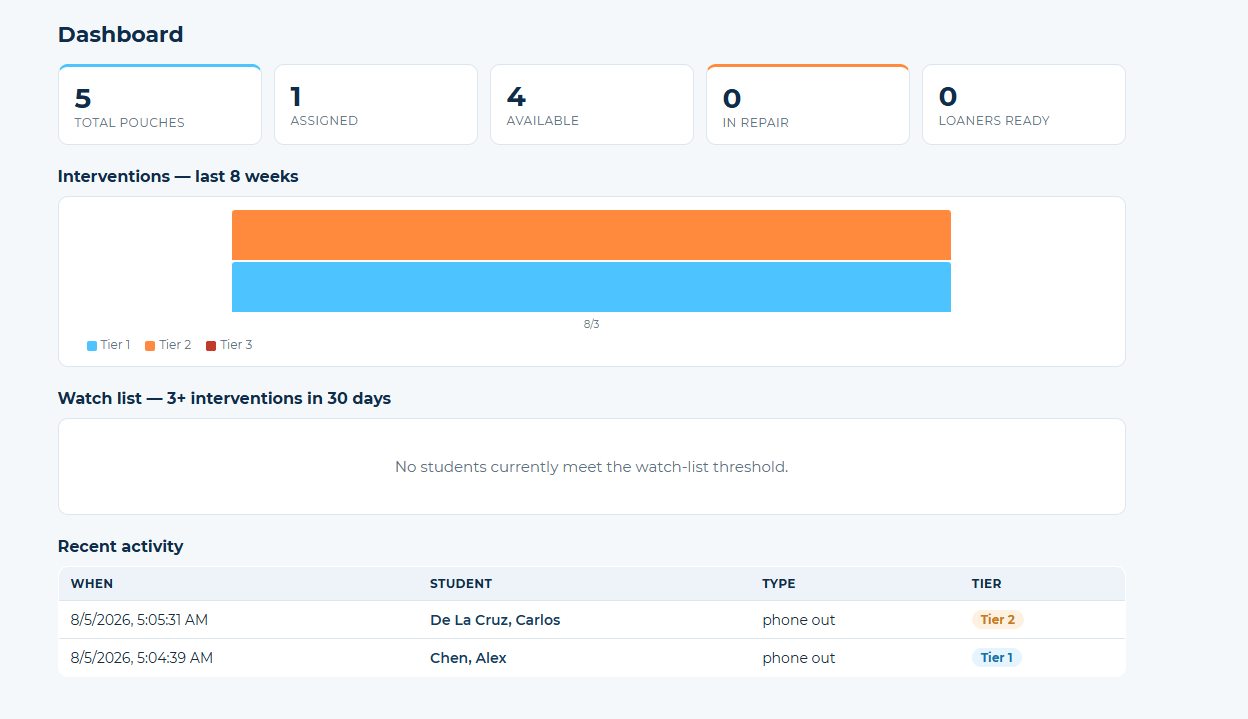
Your school becomes its own case study — no vendor claims required. When a neighboring principal asks “does it work?”, you won’t quote my website. You’ll open your dashboard.
Not ready for campus-wide? Start smaller this semester
A late-start launch doesn’t have to mean all-in. Model C puts five room-numbered pouches in each classroom, used only when a phone is caught out — a complete enforcement policy that fits in a desk drawer and launches the day the box arrives. Many schools start there in the fall and go campus-wide in spring, with teachers asking for it rather than bracing for it.
The bottom line
“We’ll wait until next August” is a rule written by systems that need installation. Safe Pouch doesn’t. Because it’s decentralized — a Magnet Unlocker in every teacher’s hands — and because safety is demonstrated in front of students and parents rather than promised on paper, a late-start launch doesn’t just work. It often works better: teachers who’ve felt the need, a rollout scoped to real campus data, families who’ve watched the emergency access with their own eyes, and a before-and-after story that belongs entirely to your school.
Launch this semester — not next year
Request a quote scoped to your enrollment and implementation model. Late-start purchases qualify under Title I, Title IV-A, and MTSS/PBIS funding — with no competitive bid required through TIPS Cooperative Purchasing Contract #250802.
Request a Quote


