
By John Nguyen — credentialed classroom teacher (15+ years), founder of Win Elements, and inventor of the Multi-Tiered Safe Pouch® (U.S. Patent No. 10,980,324 B2)
After fifteen-plus years in the classroom, I’ve learned a rule that applies to almost every school initiative: a solution that solves one problem and creates three new ones isn’t a solution — it’s a trade.
Phone-free tools are no exception. Sealed fabric pouches, hard plastic cases, and centralized phone lockers all do the one thing they promise: they get phones out of students’ hands. And to be clear — if your school already has a phone policy that’s working, that’s a win worth celebrating. But if you’re evaluating options, it’s worth asking a question most product pages never answer:
What new problems does this create on Day 2 — and who designed for them in advance?
I designed Safe Pouch as a teacher who lived those Day 2 problems. Here’s what they look like in each category, and how the Multi-Tiered Safe Pouch system was built to solve each one before it ever reaches your office.
The pattern: every single-product approach creates predictable new problems
Sealed fabric pouches: secure until 3:00 PM — then the real problem starts
Sealed fabric pouches keep phones locked all day. Then the bell rings, and 1,200 students need their pouches opened at a handful of unlocking points. That’s not a phone policy — that’s a second dismissal. Meanwhile:
- Emergencies: if a student needs their phone during a lockdown or evacuation and every unlocking point is across campus, you have a safety gap — one that parents will ask about at the very first board meeting.
- Damage economics: when a determined teenager defeats a fabric pouch (they will try — I taught teenagers), most programs make the school document it, file it, and often pay to replace it.
- The forgot-it problem: a sealed pouch has no built-in answer for the student who left it at home. Every exception becomes an improvised hallway negotiation.
Centralized phone lockers: one cabinet, thirty minutes of your day
Phone lockers and caddies solve visibility — every phone in one place. But now the school owns three new problems:
- Collection and distribution time: checking in and handing back hundreds of devices eats instructional minutes at both ends of the day, every day.
- Liability: the moment a phone leaves a student’s possession, damage, mix-ups, and “who took whose phone?” disputes become the school’s problem — and the school’s paperwork.
- Emergencies again: a student separated from their device by a locked cabinet across the building cannot call a parent when it matters most.
Hard plastic cases: durable, but heavy on cost and bulk
Hard plastic cases hold up well, but they cost several times more per student, take up serious storage space, and still leave the unlocking-bottleneck and exception problems unsolved.
None of these are bad-faith products. They’re just products — and a phone-free campus is a system problem. Systems have exceptions, emergencies, repeat offenders, forgetful kids, and budget meetings. A complete solution has to be designed for all of it.
How Safe Pouch solves each problem before it arises
1. The emergency problem — solved in the pouch itself
Every Safe Pouch is secured by a mechanical lock released by a magnet of the correct strength and pattern — and every Safe Pouch also has a built-in emergency safety access: a dedicated cut point that anyone can use in seconds, no Magnet Unlocker required. In a true emergency, a student or staff member doesn’t hunt for a device or a key — they act.
And here’s the part that surprises administrators: a pouch cut at the emergency access point is repaired free under warranty. We designed the escape hatch and budgeted for it — because a safety feature you’re afraid to use isn’t a safety feature.
2. The dismissal bottleneck — solved by putting unlocking everywhere
Safe Pouch flips the centralized model. In our most effective implementation (Model A), every teacher holds a numbered Magnet Unlocker, so pouches open in every classroom at once — dismissal takes seconds, not a second bell schedule. Budget-conscious campuses run Model B: wall-mounted Magnet Enclosures act as self-service unlocking stations while campus supervisors carry Mobile Magnet Unlockers. Either way, there is no single point of failure and no line out the door at 3:00 PM.
3. The damage problem — solved by materials, warranty, and zero paperwork
Standard Safe Pouches are made of premium thick neoprene reinforced with up to two layers of leather. When a student does manage to damage one, here’s our entire claims process: send it back, we repair it free for three years. No photos. No forms. No arguing about whether the damage was intentional — intentional damage is covered.
- Every Safe Pouch ships with a free replacement locking part.
- Out of 30,000+ pouches sold, only 3 have ever been beyond repair — a 99.99% repair success rate.
- For the rare student who can’t handle a fabric pouch at all, Safe Pouch Pro offers a translucent ABS body with a stainless-steel-reinforced leather flap.
4. The exceptions problem — solved by tiers, not improvisation
This is where “Multi-Tiered” stops being a brand name and starts being the point. Forgot-at-home days, repeat violations, and damaged pouches aren’t surprises — they’re Tuesdays. So the system has a calm, pre-decided answer for each:
- Tier 1: students carry their own Safe Pouch daily; intervention students carry a visually distinct pouch so staff support them at a glance.
- Tier 2: forgot the pouch? Check out a numbered loaner for the day. Policy intact, student in class, incident logged.
- Tier 3: damaged pouch or repeated violations? The device is checked into a numbered, foam-lined slot in our 48-slot phone storage cabinet — visible through the acrylic door, secure until dismissal or parent pickup.
The lock system escalates the same way. Lock color is authority level: a Grey School Lock releases with any teacher’s Magnet Unlocker, a White Admin Lock releases only in the office, and a Black Home Lock sends the release decision home to a parent. Consequences escalate without a single confiscation battle — and without a teacher ever having to invent policy in the hallway.
Schools that aren’t ready for a campus-wide rollout can even start with Model C: five room-numbered pouches per classroom, used only when a phone is caught out. It’s a phone policy that fits in a desk drawer.
5. The accountability problem — solved with data, included free
A binder is where phone interventions go to be forgotten. Every Safe Pouch school gets the MySafePouch app free for 3 years: live pouch inventory, one-step “phone caught out — secure it” logging, an automatic watch list for students with 3+ interventions in 30 days, and CSV exports your MTSS/PBIS team can actually use. Your phone policy stops being an opinion and becomes a dataset.
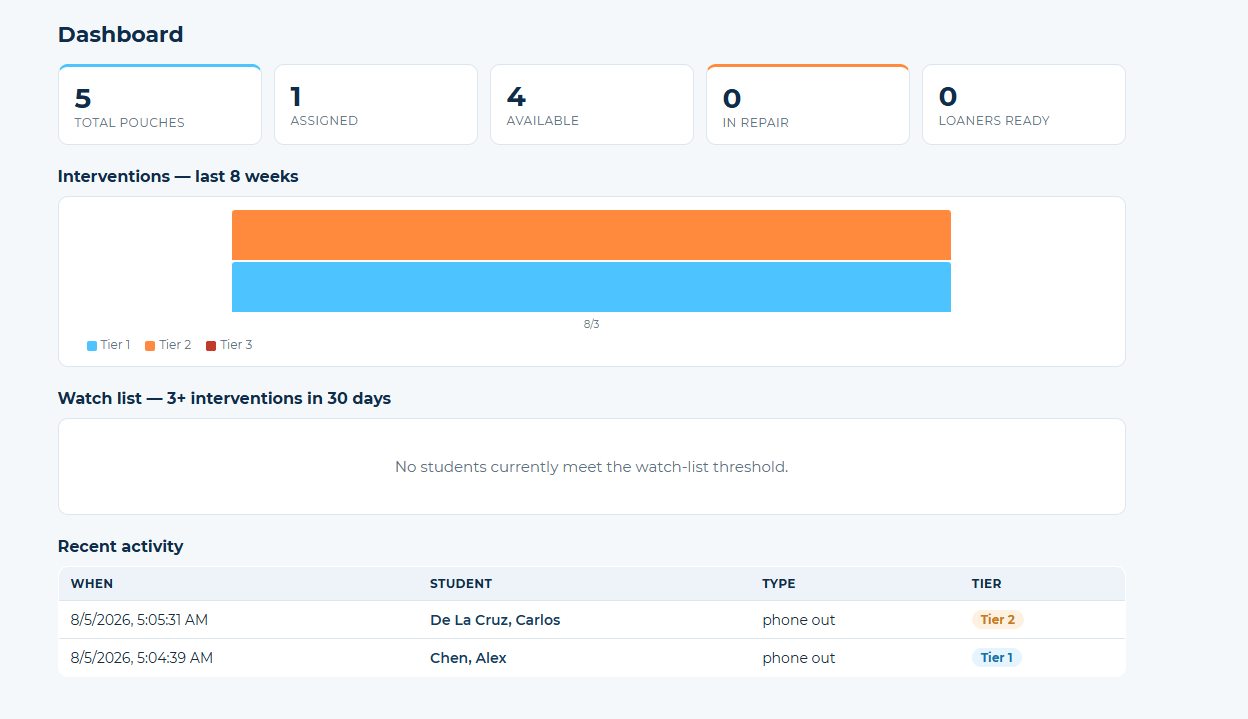
The complete system, visualized
Here’s the whole architecture on one screen — each layer exists because a real school day demanded it:
Remove any one layer and a familiar problem comes back. That’s the difference between buying a product and adopting a system.
Side by side: the Day 2 problems and who designed for them
The quick-scan version first — one glance tells the story:
Based on typical implementations in each category as of publication; individual programs vary. Details for each row below.
| Day 2 problem | Sealed fabric pouches | Centralized phone lockers | Multi-Tiered Safe Pouch® |
|---|---|---|---|
| Emergency access | Wait for an unlocking point | Phone locked across the building | Built-in emergency safety access on every pouch; free repair after use |
| Dismissal | Lines at few unlock stations | Redistribute hundreds of devices | Every teacher holds a Magnet Unlocker — pouches open campus-wide in seconds |
| Student damage | Document, file, often re-buy | School liable for devices | 3-year free repair warranty, intentional damage covered, no forms or photos |
| Forgot it at home | Improvised exceptions | Improvised exceptions | Tier 2 numbered loaners, logged automatically |
| Repeat violations | One-size-fits-all | One-size-fits-all | Escalating lock tiers (School → Admin → Home) + Tier 3 cabinet |
| MTSS data | Manual tracking, if any | Manual tracking, if any | MySafePouch app free for 3 years — live dashboard, watch list, CSV export |
Complete doesn’t mean complicated (or expensive)
A system this layered sounds like it needs an installation crew. It doesn’t. There’s nothing to install — a schoolwide launch is a 15–20 minute staff meeting and one morning at the doors. That’s also why rolling out after the year has started often works even better than a Day 1 launch: teachers have felt the need firsthand, and you have real campus data to scope with.
On budget: standard Safe Pouches start as low as $13.50 per pouch, and most schools don’t pay out of the general fund at all. Safe Pouch purchases qualify under Title I, Title IV-A, and MTSS/PBIS funding, and districts can purchase with no competitive bid through TIPS Cooperative Purchasing Contract #250802. One of the reasons I’ve never taken a salary from Win Elements is so those numbers stay where schools can reach them.
The bottom line
Sealed pouches secure phones. Lockers store phones. But a school doesn’t need a phone product — it needs a phone system: one that opens instantly in an emergency, dismisses on time, shrugs off damage, has a calm pre-decided answer for every exception, and hands your MTSS team real data. That’s what the Multi-Tiered Safe Pouch was designed to be — by a teacher, for the school days that actually happen.
See the complete system for your campus
Request a quote scoped to your enrollment and implementation model. We’ll map it to your Title I, Title IV-A, or MTSS/PBIS funding pathway — no competitive bid required through TIPS Contract #250802.
Request a Quote